
×
NetEffect Joins Taazaa to Expand Enterprise AI, Platform Integration, and Modernization Services. Learn more
Categories
AEM

How Adobe Experience Manager Guides Works Under the Hood: Features & Architecture 

Key Takeaways

  • Adobe Experience Manager (AEM) Guides isn’t just a documentation interface. It’s a structured content engine built on Adobe Experience Manager as a Cloud Service (AEMaaCS).
  • Its architecture separates content from presentation using DITA XML and Dynamic XML (DXML), enabling reusable, component-level publishing.
  • AEM Guides leverages the native architecture of AEMaaCS, including cloud-native scalability and repository services.
  • Governance, versioning and multi-channel publishing are embedded into the architecture. Not layered on afterward.
  • Enterprises adopting AEM Guides gain structural control over long-form content without deploying a disconnected CCMS platform.

Why “Under the Hood” Matters for Enterprise Leaders

Most enterprise teams evaluating Adobe Experience Manager (AEM) Guides focus on features. Structured authoring. Multi-channel publishing. Version control.

But features only tell part of the story.

Here’s what we’ve noticed after years of implementation work: architecture determines whether those features actually scale. You can have the most impressive feature list in the world, and it won’t matter if the foundation can’t support real-world demands.

According to Adobe Experience League, the platform is built on Dynamic XML (DXML), a processing framework that enables structured XML content to be managed and rendered dynamically within AEM. This architectural design allows content to be stored once as structured XML and published to multiple output formats on demand.

Unlike traditional documentation systems where content exists in format-specific silos, AEM Guides maintains a single source that can generate outputs for AEM Sites, PDF, HTML5, EPUB, JSON and custom formats through publishing presets. Changes to source content propagate across all outputs when republished, eliminating manual duplication.

That separation between storage and presentation isn’t cosmetic. It’s structural. And that distinction matters more than most evaluation checklists acknowledge.

The Foundation: DITA XML and Dynamic XML (DXML)

At its core, AEM Guides relies on Darwin Information Typing Architecture (DITA) XML for structured authoring.

DITA enables topic-based content modeling, allowing authors to create modular content units that can be reused across deliverables. Think of it like building with standardized components rather than crafting everything from scratch each time.

Dynamic XML acts as the runtime processing layer.

It enables structured XML content to be rendered dynamically within AEM without requiring pre-generated outputs for every scenario.

So what does this actually mean in practice?

Content is stored as structured XML. Rendering happens dynamically. Reuse becomes native to the system rather than bolted on. Output stays flexible.

Unlike traditional documentation systems that generate static files, DXML allows content to exist independently of its final format. We’ve seen teams struggle with legacy systems where changing one paragraph meant regenerating entire document libraries. That pain point disappears here.

This is foundational to omnichannel publishing.

How AEM Guides Integrates with AEMaaCS

AEM Guides doesn’t operate as a standalone platform. It runs within AEMaaCS.

The platform is built as a cloud-native, service-based system that supports continuous updates, elastic scaling and modular services.

This means AEM Guides inherits cloud-native scalability, managed infrastructure, automated updates, repository services and security layers. All of it comes bundled together.

From an architectural standpoint, AEM Guides sits on top of the AEM repository (based on Apache Jackrabbit Oak), using it to store structured XML content and associated assets.

Because it operates inside the same ecosystem as AEM Sites and Assets, enterprises can unify marketing content, documentation, knowledge bases and regulatory materials under a single content platform.

That architectural unification is a significant departure from legacy CCMS deployments that require separate infrastructure. We’re not saying those legacy systems don’t work. They do. But maintaining parallel systems creates overhead that compounds over time.

Content Storage and Repository Architecture

Structured XML topics created in AEM Guides are stored in the same repository structure as other AEM assets.

Adobe’s Cloud Service architecture documentation outlines how the repository layer manages content persistence, versioning and indexing.

In practice, this translates to XML topics that are version-controlled, metadata that’s centrally managed, access control enforced at the repository level and search capabilities that leverage the underlying Cloud Service architecture.

This tight integration ensures that documentation content isn’t siloed. It becomes part of the broader digital ecosystem. Enterprises use this unified architecture to eliminate disconnected documentation silos.

Publishing Architecture: Single Source, Multiple Outputs

One of the most misunderstood aspects of AEM Guides is its publishing engine. Teams often underestimate what’s happening beneath the surface.

Adobe documentation describes how structured DITA content can be transformed into multiple output formats, including HTML, PDF and other channel-specific deliverables.

The publishing pipeline works by pulling structured XML topics, applying transformation rules and generating channel-specific outputs dynamically.

Because the source content remains structured and modular, changes propagate across outputs without manual rewriting. This is a core architectural difference from page-based systems. A small distinction on paper. A massive operational difference in reality.

In enterprise environments, this enables consistent policy updates across documentation, faster product documentation releases and synchronized updates across portals and downloadable materials.

It also reduces operational risk. When your compliance team updates a regulatory disclosure, that change flows through every relevant output automatically. No hunting through folders. No hoping someone remembered to update the PDF version.

Governance and Workflow Architecture

AEM Guides inherits workflow capabilities from AEMaaCS.

Adobe’s Cloud Service documentation explains that workflows and access controls are embedded into the platform’s service architecture.

In AEM Guides, this translates into role-based authoring permissions, review and approval workflows, version history tracking and auditability of changes.

Because governance is built into the repository and workflow engine, compliance becomes systemic rather than manual. We’ve worked with regulated industries where this distinction alone justified the platform investment.

Architecture matters because governance must scale. You can’t manually audit 10,000 documents every quarter. The system has to do it for you.

Performance and Scalability Considerations

AEMaaCS operates on a service-oriented, containerized architecture that supports auto-scaling and managed performance. Cloud Service environments benefit from automated scaling and continuous performance optimization.

When AEM Guides runs inside this architecture, large documentation libraries scale elastically, rendering processes benefit from managed services and updates are delivered without traditional upgrade projects.

However, and this is worth pausing on, Cloud Service doesn’t compensate for poor content modeling.

Structured content reduces duplication and improves indexing efficiency. Unstructured documentation increases complexity. We’ve seen organizations migrate to cloud infrastructure expecting performance improvements, only to discover their content architecture was the bottleneck all along.

Cloud amplifies both good and bad architecture. That’s not a criticism of the platform. It’s just reality.

Where Enterprises See Architectural Advantage

Enterprises that adopt AEM Guides typically experience architectural benefits in three areas.

Platform Consolidation. Instead of maintaining a web CMS, a separate CCMS and a disconnected knowledge base, organizations unify structured documentation and digital experiences in one platform.

Governance Alignment. Compliance, version control and access permissions operate within a shared architecture. Auditability improves without additional tooling.

Operational Efficiency. Reusable content reduces duplication. Publishing cycles shorten. Localization workflows simplify.

These outcomes are architectural, not cosmetic. You can’t achieve them by adding features to a fundamentally different system.

When AEM Guides Is Not the Right Fit

Let’s be honest about limitations.

AEM Guides is most valuable when documentation volume is high, multi-format publishing is required, regulatory compliance is critical and reuse is essential.

Organizations with minimal documentation complexity may not require structured CCMS architecture. If you’re managing a handful of product manuals that change once a year, this might be more infrastructure than you need.

Architecture should match operational need. Not the other way around.

Architecture Determines Scalability

AEM Guides works because of how it’s built.

Its reliance on DITA XML, Dynamic XML processing and integration with AEMaaCS creates a structured, reusable and governed content ecosystem.

Features attract attention. Architecture determines longevity.

For enterprises evaluating AEM Guides, the key question isn’t whether it supports structured authoring. It’s whether your organization is architecturally prepared to leverage it.

If you want to assess how AEM Guides would integrate into your Cloud Service architecture, talk to one of our AEM experts to determine what that structure could look like.

Frequently Asked Questions

Q1. What is Dynamic XML (DXML) in AEM Guides?

Dynamic XML is the processing framework described in Adobe Experience League documentation that enables structured XML content to be rendered dynamically within AEM without pre-generating static outputs.

Q2. How does AEM Guides integrate with AEMaaCS?

AEM Guides runs inside AEMaaCS and leverages its repository, workflow engine and cloud-native architecture for scalability, versioning and security.

Q3. Is AEM Guides a separate CCMS platform?

No. AEM Guides operates within AEM, allowing structured documentation and digital content to coexist in a unified architecture.

Q4. Does AEM Guides support multi-channel publishing?

Yes. According to Adobe documentation, structured DITA content can be transformed into multiple output formats, including HTML and PDF, from a single source.

Q5. Why does architecture matter when evaluating AEM Guides?

Architecture determines scalability, governance and operational efficiency. Structured content and cloud-native integration reduce duplication and improve compliance control over time.
Categories
AEM

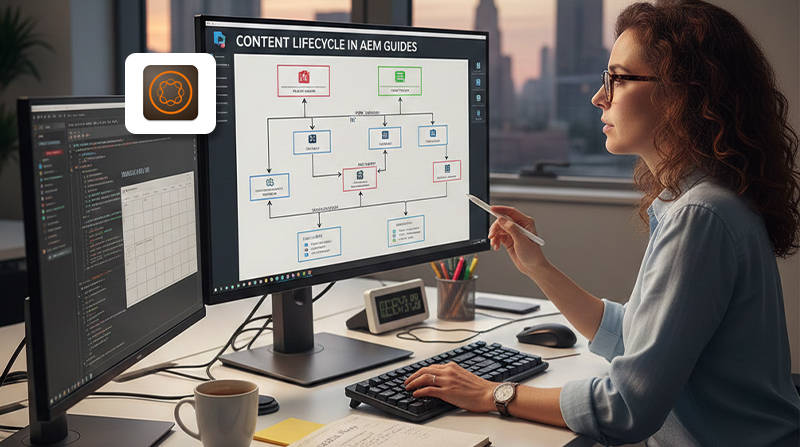
How to Manage Content Lifecycle in AEM Guides 

Key takeaways 

  • AEM Guides manages content as a lifecycle, not a one-time publish event 
  • Structured workflows reduce review delays and governance gaps 
  • Document states bring clarity to ownership and readiness 
  • Reuse and version control lower long-term maintenance effort 
  • Lifecycle discipline directly improves speed, quality and compliance 

Every content team reaches a moment of friction. Drafts pile up. Reviews stall. Updates land late or worse, land in the wrong place. Nobody planned for chaos, but complexity crept in anyway. 

This is where Adobe Experience Manager (AEM) Guides, changes the conversation. It treats content as a living asset, not a static deliverable. The platform is built to manage the entire content lifecycle, from authoring through review, publication, reuse and retirement, with structure and accountability baked in. 

Let’s walk through how content lifecycle management actually works in AEM Guides, what problems it solves and how teams can use it to regain control as content scales. 

Why Content Lifecycle Management Breaks Down in Large Teams 

Content doesn’t fail because teams lack tools. It fails because ownership blurs over time. 

In unstructured environments, content often lives in shared folders, emails or page-based CMS workflows. Drafts move forward without context. Reviews happen inconsistently. Published content stays live long after it should have been updated or retired. 

As volume grows, teams face familiar pain points: 

  • No single source of truth 
  • Manual review cycles that slow delivery 
  • Difficulty tracking what is approved, outdated or in progress 
  • Risky updates that break reused content 

AEM Guides addresses these issues by anchoring content lifecycle management in structure, workflow and state. 

How AEM Guides Defines the Content Lifecycle 

AEM Guides is built on DITA XML, which already assumes that content evolves over time. Topics are created, reviewed, published, reused, revised and eventually retired. 

The platform formalizes this lifecycle through three core mechanisms: 

  • Structured authoring and versioning 
  • Workflow-driven reviews and approvals 
  • Document states that reflect real content readiness 

If you want a baseline understanding of the platform itself, this overview of what AEM Guides is provides helpful context. 

Structured Authoring as the Starting Point 

Lifecycle management starts at authoring. In AEM Guides, content is created as structured DITA topics rather than freeform pages. 

This matters because structure: 

  • Enforces consistency from the first draft 
  • Makes reuse predictable and safe 
  • Allows lifecycle actions to apply at the topic level 

Authors work inside a web-based editor that validates structure automatically. Errors surface early, not during publishing. Over time, this reduces rework and downstream review friction. 

For teams new to structured content, DITA 101: structured content for reuse and compliance explains why this model scales better than page-based authoring. 

Version Control and Traceability 

Every topic in AEM Guides is versioned. This is not a cosmetic feature. It is the backbone of lifecycle control. 

Versioning allows teams to: 

  • Track who changed what and when 
  • Roll back safely when issues arise 
  • Compare revisions during review cycles 

Because reuse is reference-based, a single topic version can appear in multiple deliverables. Updates are deliberate, visible and auditable. 

In regulated or high-risk environments, this traceability becomes essential rather than optional. 

Document States Bring Clarity to Content Readiness 

One of the most practical lifecycle features in AEM Guides is document state management. 

Document states reflect where content sits in its lifecycle. Common examples include: 

  • Draft 
  • In review 
  • Approved 
  • Published 
  • Archived 

These states are not just labels. They can drive permissions, workflows and publishing rules. 

For example: 

  • Only approved content can be published 
  • Archived topics are excluded from outputs 
  • Draft content remains visible only to authors 

AEM Guides lets teams customize document states to match their internal processes. This flexibility is useful for organizations with complex approval or compliance requirements. 

Document states replace guesswork with clarity. Everyone knows what is ready, what is blocked and what is no longer valid. 

Workflow-Driven Reviews and Approvals 

Lifecycle management breaks down fastest during reviews. Emails get missed. Feedback gets lost. Deadlines slip. 

AEM Guides integrates structured workflows directly into the authoring environment. Reviews are assigned, tracked and enforced by the system. 

Key workflow benefits include: 

  • Clear ownership at each stage 
  • Parallel or sequential reviews 
  • Automated notifications and reminders 
  • Audit trails for approvals 

This aligns closely with broader AEM governance patterns. For a deeper look at how workflows support accountability, see Enforcing Content Governance with AEM Workflows. 

Publishing as a Controlled Lifecycle Step 

In AEM Guides, publishing is not the end of the lifecycle. It is one controlled step within it. 

Teams can publish content to: 

  • PDF outputs 
  • HTML deliverables 
  • AEM Sites for web experiences 

Because publishing is rule-based, only content in the correct state is included. Conditional attributes ensure that the right variations reach the right audiences. 

This reduces last-minute fixes and prevents incomplete or unapproved content from going live. 

Reuse and Lifecycle Impact 

Reuse is where lifecycle discipline pays off over time. 

When content is reused correctly: 

  • Updates happen once, not dozens of times 
  • Reviews focus on meaningful changes 
  • Outdated content is easier to identify and retire 

AEM Guides tracks where topics are used, which makes lifecycle decisions safer. Before updating or archiving a topic, teams can see its downstream impact. 

This visibility is difficult to achieve in traditional CMS setups. 

Managing Updates, Retirement and Cleanup 

Content lifecycle management does not end at publication. Over time, content must be reviewed, refreshed or retired. 

AEM Guides supports this through: 

  • Usage reports that highlight heavily reused topics 
  • Version histories that show content age 
  • Document states that mark content as obsolete 

Teams can archive content without deleting it, preserving history while keeping outputs clean. 

This discipline prevents content sprawl, which is one of the most common long-term problems in enterprise documentation systems. 

Common Lifecycle Challenges AEM Guides Helps Resolve 

Challenge How AEM Guides helps 
Unclear ownership Workflow assignments and document states 
Review bottlenecks Automated, trackable approvals 
Risky updates Versioning and reuse visibility 
Outdated content Lifecycle states and archiving 
Compliance gaps Audit trails and controlled publishing 

How Lifecycle Management Supports Broader AEM Strategy 

Content lifecycle discipline does not live in isolation. It supports broader digital experience goals. 

When content is structured, governed and lifecycle-aware: 

  • AEM Sites teams move faster 
  • Personalization programs rely on trusted content 
  • Customer journeys stay consistent across channels 

If your broader AEM platform is already showing signs of strain, getting your AEM implementation back on track outlines where lifecycle gaps often appear first. 

Lifecycle Discipline is a Growth Strategy 

Managing content lifecycle in AEM Guides is not about process overhead. It’s about protecting quality as scale increases. 

Structured authoring, version control, document states and workflows work together to keep content accurate, reusable and accountable over time. 

If your organization treats content as a long-term asset rather than a one-off deliverable, lifecycle management stops being optional. It becomes the foundation. 

If you are planning to adopt AEM Guides or struggling to govern content at scale, NetEffect can help design lifecycle models that align with your teams, tools and growth plans. Talk to us about making content sustainable. 

Frequently Asked Questions 

What is content lifecycle management in AEM Guides? 

Content lifecycle management in AEM Guides refers to the structured way content is created, reviewed, approved, published, reused, updated and eventually retired. Each stage is supported by built-in versioning, workflows and document states. This ensures content moves forward with clear ownership and accountability. It also helps teams avoid outdated or inconsistent information remaining live longer than intended. 

How do document states help content teams? 

Document states provide clear visibility into where content sits in its lifecycle, such as draft, in review, approved or archived. These states are more than labels, they control permissions, publishing eligibility and workflow behavior. Teams no longer need to guess whether content is ready or blocked. This clarity reduces review delays and prevents incomplete content from reaching production. 

Can workflows be customized in AEM Guides? 

Yes, workflows in AEM Guides are highly configurable to match how teams actually work. Organizations can define review stages, approval roles and escalation paths based on internal governance needs. This is especially useful for enterprises with compliance, legal or multi-team review requirements. Custom workflows ensure process discipline without forcing teams into rigid, one-size-fits-all models. 

Does lifecycle management increase authoring effort? 

In most cases, it reduces overall effort rather than adding to it. While structure and workflows introduce some upfront discipline, they eliminate repeated rework, unclear feedback loops and manual tracking. Authors spend less time chasing approvals or fixing downstream issues. Over time, this leads to faster publishing cycles and more predictable delivery. 

Is AEM Guides suitable for non-regulated industries? 

Yes, content lifecycle management is valuable well beyond regulated environments. Marketing, product and support teams also benefit from clearer ownership, safer reuse and controlled updates. As content volume grows, informal processes tend to break down. AEM Guides helps teams maintain quality and speed even when compliance is not the primary driver. 

Categories
AEM

How does AEM Guides leverage DITA XML? 

Key Takeaways

  • AEM Guides uses DITA XML as a structured backbone, not a formatting layer
  • DITA enables true content reuse, version control and conditional publishing
  • AEM Guides brings DITA into a modern, web-based authoring and delivery model
  • Structured content reduces duplication, risk and long-term maintenance costs
  • The real value shows up at scale, across products, channels and teams

We’ve all seen it happen. Documentation grows fast, teams grow faster and suddenly the same paragraph lives in ten places, slightly different each time. Updates turn risky. Compliance checks turn slow. Writers spend more time hunting content than shaping it.

This is where Adobe Experience Manager (AEM) Guides earns its place. At its core, it is built around Darwin Information Typing Architecture (DITA) XML, a structured authoring standard designed for reuse, scale and precision. Not as a side feature. As the foundation.

Let’s walk through how AEM Guides actually leverages DITA XML, what that means in real projects and why enterprises lean on this combination when content starts to matter more than volume.

Why DITA XML Still Matters

DITA isn’t new. What makes it relevant today is not age but discipline.

DITA enforces structure. Every piece of content has a role, a type and rules. Tasks are tasks. Concepts are concepts. References stay references. That consistency is what makes reuse and automation possible.

Without structure, content systems rely on human memory. With DITA, systems do the remembering.

If you want a deeper foundation on this, our NetEffect team breaks it down in DITA 101: Structured Content for Reuse and Compliance, which shows how structured authoring reduces risk in regulated and complex environments.

Learn More: What is AEM Guides?

What AEM Guides Adds on Top of DITA

DITA alone does not solve workflow, usability or publishing complexity. That is where AEM Guides steps in.

AEM Guides is Adobe’s enterprise component content management system (CCMS) built natively on Adobe Experience Manager. It doesn’t replace DITA. It operationalizes it.

Here’s how.

Structured Authoring Through the Web Editor

AEM Guides provides a browser-based Web Editor that understands DITA semantics. Writers are not dealing with raw XML unless they choose to. Instead, they work inside a structured interface that enforces DITA rules quietly in the background.

What this means in practice:

  • Content types are predefined and validated
  • Invalid structures are blocked early, not caught later
  • Authors focus on meaning, not markup

This reduces onboarding time without compromising structure. Teams get consistency without turning writers into XML specialists.

Topic-Based Content as a First-Class Concept

DITA is topic-driven by design and AEM Guides fully embraces that.

Each topic is stored once and reused wherever needed. A single safety warning, procedure or legal note can appear across multiple guides, products or regions.

When that topic changes, every place it appears updates automatically.

This is not copy-paste reuse. It is reference-based reuse, which is a critical difference.

Learn More: DITA 101: How Structured Content Enables Reuse, Localization and Compliance

Content Reuse and Conditional Publishing

One of the strongest advantages of DITA is conditional text. AEM Guides exposes this capability cleanly.

Teams can tag content with conditions such as:

  • Product variants
  • Regions and locales
  • Customer tiers
  • Regulatory environments

During publishing, AEM Guides assembles the right version of content for the right audience. No forks. No manual pruning.

This becomes especially valuable when documentation supports multiple products or markets from a shared source.

Version Control and Governance at Scale

DITA XML content in AEM Guides lives inside AEM’s repository. That brings enterprise-grade versioning, permissions and workflows into the picture.

Editors can:

  • Track changes at the topic level
  • Roll back safely when needed
  • Enforce reviews before publication

When paired with AEM workflows, content governance stops being aspirational and becomes operational. We explore this more deeply in Enforcing Content Governance with AEM Workflows, which shows how structure and process reinforce each other.

Learn More: How to Enforce Content Governance Using AEM’s Page Publication Workflows

Multi-Channel Publishing Without Rewriting

DITA was designed for multi-channel delivery long before omnichannel became a buzzword.

AEM Guides extends that promise by publishing structured DITA content to:

  • PDF outputs
  • HTML and responsive web experiences
  • Adobe Experience Manager Sites
  • APIs for downstream systems

The same source feeds all channels. Formatting adapts. Content stays consistent.

This approach aligns closely with how modern digital experience platforms expect content to behave: modular, composable and channel-agnostic.

How AEM Guides Supports Translation and Localization

Structured content simplifies translation. AEM Guides builds on that with native localization workflows.

Because topics are reused and versioned, translation teams only work on what changed. Not entire documents. This reduces cost, turnaround time and errors.

DITA’s structure also improves translation memory efficiency, which matters when content volumes grow.

Real-World Benefits at Enterprise Scale

Here is where theory meets delivery.

Organizations that adopt AEM Guides with DITA XML typically see:

Area Impact 
Content reuse Fewer duplicates, single source of truth 
Authoring efficiency Faster updates, less rework 
Compliance Easier audits and controlled changes 
Localization Lower translation costs 
Publishing Consistent output across channels 

These gains compound over time. The larger the content ecosystem, the greater the return. This is why AEM Guides often enters the picture when documentation moves from a cost center to a strategic asset.

How This Fits Into the Broader AEM Ecosystem

AEM Guides does not live in isolation. It integrates directly with Adobe Experience Manager Sites, Assets and workflows.

That matters when documentation supports customer journeys, not just products.

Structured content created in AEM Guides can feed experiences that are personalized, contextual and consistent across touchpoints. This is where documentation starts contributing to experience design, not just support.

If your AEM platform is struggling under content complexity, our guide on Getting Your AEM Implementation Back on Track outlines the common pitfalls and where structured content often fits into the fix.

Learn More: Get your Adobe Experience Manager (AEM) implementation on track

Where Teams Often Hesitate and What to Ask Instead

DITA can feel intimidating at first. The structure forces decisions early which isn’t always comfortable.

The better question is not, “Is DITA too rigid?” but rather, “How much flexibility do we actually need and how much inconsistency can we afford?”

For teams managing large, regulated or fast-changing content sets, structure is not a constraint. It is a safeguard.

Structure as a long-term advantage

AEM Guides leverages DITA XML by staying faithful to its principles while removing its friction. Structured authoring, true reuse, controlled publishing and enterprise governance all come together in one system.

This is not about writing more content. It’s about managing content responsibly as it grows.

If your documentation ecosystem is expanding or already straining, this combination deserves a serious look.

If you are evaluating AEM Guides or trying to align structured content with your broader AEM strategy, talk to our team at NetEffect. We help enterprises design, implement and scale content systems that last.

Frequenty Asked Questionss

Q1. What role does DITA XML play inside AEM Guides?

DITA XML is the structural backbone of AEM Guides. It defines how content is authored, validated, reused and governed across the platform. By enforcing consistent topic structures, DITA allows teams to update content once and reflect those changes everywhere it is used. This reduces duplication and improves long-term maintainability.

Q2. How does AEM Guides improve content reuse compared to traditional CMS platforms?

Traditional CMS platforms reuse content at the page level, which often leads to duplication. AEM Guides uses DITA’s topic-based model, allowing individual sections, warnings or procedures to be reused across multiple outputs. Updates happen centrally, not manually. This approach improves consistency and significantly reduces authoring and translation effort at scale.

Q3. Can non-technical writers realistically work in AEM Guides?

Yes. AEM Guides provides a web-based editor that hides most XML complexity while still enforcing DITA structure. Writers work within guided templates and validated content types rather than raw markup. This allows editorial teams to focus on clarity and accuracy without needing deep technical skills, even in large, distributed teams.

Q4. How does AEM Guides support multi-channel publishing and AEM Sites?

AEM Guides publishes structured DITA content to multiple formats from a single source. Teams can generate PDFs, HTML outputs and content for AEM Sites without rewriting material. Because structure and presentation are separated, formatting can change without affecting source content. This supports consistent delivery across documentation and digital experiences.

Q5. Why is AEM Guides a strong fit for regulated or complex industries?

Regulated industries require controlled change, traceability and consistency. AEM Guides supports these needs through topic-level versioning, approval workflows and conditional publishing. Teams can manage variations by product, region or regulation without branching entire documents. This reduces compliance risk while keeping content manageable as complexity grows.

Categories
AEM

Migrating Legacy Documentation into AEM Guides: Process and Tools 

Key Takeaways

  • Migration moves from static document silos to a dynamic, structured content ecosystem using DITA (XML).
  • A structured three-month timeline covering assessment, remediation and deployment ensures a predictable transition with minimal content freeze.
  • High-tech organizations leverage AEM Guides to unify technical documentation with marketing assets, securing a single source of truth.
  • Structured migration reduces localization costs and eliminates the manual coordination tax associated with version updates.
  • Integration with AEM workflows enforces compliance and quality standards across the global content supply chain.

Even with the best of intentions, many organizations spread their technical documentation in various locations. It doesn’t happen all at once, but slowly. A user manual sits in FrameMaker. Release notes are hidden in Word. API guides live in GitHub. Nobody planned it that way. Growth just made it happen.

Then someone asks a simple question: “Where’s the latest spec for Feature X?”

And you realize the answer requires opening four files, cross-referencing three versions and hoping nothing got missed in translation.

That’s your migration moment.

When Documents Become Bottlenecks

Modern enterprises collect data faster than they can organize it. In sectors like high-tech and SaaS, product knowledge gets trapped. Legacy Word files. FrameMaker documents. HTML silos scattered across servers.

Manual updates turn into high-risk coordination exercises. One feature change forces writers to hunt through dozens of manuals. It’s slow. Prone to error. And it scales poorly.

Adobe Experience Manager (AEM) Guides offers a different approach. Instead of thinking in documents, you think in components. Documentation becomes modular data. That unlocks reuse across portals, apps and AI interfaces. A unified environment where content flows instead of sits.

But getting there requires more than an upload. Success demands a rigorous migration strategy that preserves integrity, enforces governance and sets the stage for a composable tech stack with AEM.

Content Assessment and Modeling

The first phase isn’t technical. It’s analytical.

Before refactoring a single line of code, audit the legacy library. Look for content debt: inconsistent terminology, duplicate instructions, outdated safety warnings. The things that accumulated when nobody was watching.

Data Cleanup and Remediation

Legacy content carries formatting baggage. Manual overrides in Word. Proprietary tags in FrameMaker. Structural quirks that will break a clean XML schema. Organizations face a choice:

Automated Conversion: Tools like the AEM Guides ingestor map legacy styles to DITA elements. It’s ideal for large-scale migrations where bulk structural mapping can run via scripts. Fast but requires validation.

Manual Refinement: Reserve human intervention for high-value core topics that need new metadata tagging or structural changes. Slower but precise.

Most migrations blend both. Automate what you can, refine what matters.

Information Typing

Successful migration sorts content into three DITA pillars. Concepts explain the why. Tasks walk through the how. Reference provides the specs. This classification prevents content blurring and prepares documentation for a scalable AEM component library.

Not every paragraph fits neatly. That’s fine. The goal is clarity, not perfection.

The Three-Month Blueprint

A common fear is that migrating legacy documentation disrupts daily operations for months. Industry benchmarks tell a different story. A methodical transition can execute in a three-month window without freezing the live site.

Month 1: Assessment and Cloud Readiness

The focus here is on infrastructure. If moving to AEM as a Cloud Service, refactor deprecated code and prepare the Cloud Manager environment. Unlike on-premise setups, the cloud model shifts costs from CapEx to OpEx. You get automated updates and 99.9% uptime.

According to Adobe’s own migration documentation, cloud readiness also involves validating current integrations and identifying potential conflicts before content moves.

Month 2: Code Migration and Content Ingestion

This is where the actual move happens. Content ingests in parallel with live operations. Technical teams validate third-party integrations, such as CRM or PLM systems. Content teams map legacy files into DITA maps.

Parallel operation is key. Users don’t see disruption while the new system builds underneath.

Month 3: Testing, Training and Final Go-Live

The final month dedicates to User Acceptance Testing (UAT) and team enablement. Because AEM Guides shares a backend with the standard AEM interface, the learning curve for authors drops significantly.

The goal is simple: decouple marketing campaigns from technical deployment windows. Allow faster time-to-market for product documentation.

Strategic Migration Tools

Adobe provides a suite of native tools to streamline the transition from unstructured data to structured XML. Tool selection depends on source format and target schema complexity.

AEM Guides Ingestor: The workhorse for migrating Word (.docx) and HTML content. Administrators define mapping files that translate legacy heading levels, lists and tables into valid DITA elements. It’s not magic, but it’s close.

FrameMaker to DITA Conversion: For high-tech companies with a FrameMaker history, migration is even smoother. FrameMaker’s native DITA support allows direct export-import into the AEM repository. One format in, one format out.

JSON and Markdown Ingestion: Modern software teams embrace “docs-as-code.” AEM Guides supports ingestion of Markdown and JSON, keeping developer-facing API documentation in sync with core product manuals.

Strategic migration requires initial investment in data cleanup. But the move eliminates long-term operational bottlenecks. Structured content models reduce localization overhead and manual maintenance. These efficiencies deliver significant ROI as the organization scales content output.

Performance and Edge Delivery

A strategic benefit of migrating technical documentation into the AEM Cloud environment is access to Edge Delivery Services (EDS). Traditional documentation portals often suffer from slow loading times due to heavy server-side processing of complex XML maps.

EDS provides a performance-first architecture that can achieve a 100% Lighthouse score. It introduces document-based authoring, where subject matter experts contribute content via familiar tools like Google Docs or Microsoft Word. AEM then renders these into high-performance web pages.

This democratizes content creation. It removes the technical barrier for engineers who hold critical product knowledge but may not be XML-proficient.

Governance and Scalability

One primary driver for a CCMS migration is the need for strict governance. In regulated industries like semiconductors or medical devices, an error in a manual isn’t just a typo. It’s a compliance failure.

By enforcing content governance with AEM workflows, organizations ensure no topic publishes without passing through rigorous review cycles. This structured approach also streamlines localization.

Instead of translating a 500-page manual, the system identifies only the specific components or topics that changed. Word count sent to translation agencies drops drastically. So does cost.

The Business Case

Migration to AEM Guides isn’t merely backend refactoring. It’s a growth enabler. It allows high-tech firms to:

Unify the Brand Voice: Ensure tone in technical manuals matches the sophistication of the marketing site.

Achieve Omnichannel Reach: Push the same Safety Warning component to a web portal, mobile app and customer support chatbot simultaneously.

Reduce Coordination Tax: Eliminate weeks of manual labor required to manage versions and releases across global markets.

According to a 2021 Forrester study commissioned by Adobe, 57% of organizations interested in or planning to implement a CCMS expected it would increase their ROI on content strategy, while 50% anticipated reduced translation costs.

AEM implementations deliver better ROI when they move beyond simple page management and embrace the power of structured, intelligent content.

Future-Proof Content Architecture

The move from legacy documentation to AEM Guides represents a fundamental evolution in how an enterprise communicates with customers. It’s a transition from being a publisher of documents to a provider of precision information.

By breaking down content silos and embracing a modular, cloud-based architecture, organizations ensure their documentation is as innovative as the products they support. A successful migration saves time and creates a scalable, compliant and highly efficient content supply chain ready for the demands of the next decade.

Ready to architect your migration? NetEffect helps enterprises bridge the gap between legacy data and a modern, cloud-first content ecosystem. Whether navigating a complex DITA transition or looking to optimize AEM Cloud performance, our team provides the strategic oversight needed to turn documentation into a business asset.

Contact NetEffect to Start Your Migration Journey

Frequently Asked Questions

Q1. How does the content freeze work during migration?

Most organizations use incremental migration tools to keep freezes minimal. While new feature development typically pauses during final environment setup, the actual freeze on content updates can often be limited to the final cut-over window.

Q2. Can we migrate from non-Adobe systems into AEM Guides?

Yes. Using tools like Project Site Lip and agentic AI, AEM Guides can scan non-AEM sites, analyze content purpose and map it to corresponding blocks in your new AEM environment.

Q3. What is the biggest technical challenge during migration?

The most significant hurdle is often “dirty data” from legacy Word files. Standardizing styles and ensuring that lists, tables and nested elements follow a valid DITA schema is the most labor-intensive part of the process.

Q4. Does AEM Guides support headless documentation?

Absolutely. Because DITA content is presentation-neutral XML, AEM can serve that content via APIs to mobile apps, IoT devices or third-party developer portals without requiring manual reformatting.

Categories
AEM

From RFP to Go-Live: How Enterprises Implement AEM Successfully 

Key Takeaways

  • Success begins with an RFP that prioritizes business outcomes and technical scalability over mere feature checklists.
  • Implementing AEM workflows and content governance early prevents the typical “content sprawl” that drains ROI post-launch.
  • Modern AEM implementations favor a composable tech stack, allowing enterprises to integrate best-of-breed tools without vendor lock-in.
  • Building a reusable component library is the most effective way to reduce long-term development costs and ensure brand consistency.
  • The “Go-Live” phase is not the finish line. Successful enterprises use data-driven debugging and performance monitoring to continuously refine the CX.

For a global enterprise, choosing Adobe Experience Manager (AEM) is a statement of intent. It signals a move toward customer experiences that actually work and content that scales. But here’s the thing: the gap between purchasing the license and achieving a successful “Go-Live” is often where the most ambitious digital transformations fall apart.

AEM implementation is not a “plug-and-play” exercise. It’s an intricate orchestration of technical architecture, content strategy and organizational change. To move from the Request for Proposal (RFP) to a high-performing production environment, enterprises must follow a rigorous, phase-based roadmap that prioritizes results over reports.

The Strategic RFP: Setting the Foundation

Most failed implementations can be traced back to a poorly defined RFP. If the initial document focuses solely on “features” rather than “outcomes,” the project risks scope creep from day one. An enterprise RFP for AEM must address the complexity of the existing ecosystem.

Before engaging AEM implementation partners, the organization must define its North Star. Are you solving for localized content delivery across 50 countries? Or are you focused on consolidating disparate legacy systems into a composable tech stack with AEM?

A successful RFP doesn’t just ask “Can AEM do this?” It asks, “How will AEM integrate with our existing PIM, CRM and ERP to drive a unified customer journey?” This clarity ensures that when you choose a partner, they’re aligned with your long-term business maturity, not just your immediate technical needs.

Discovery and Architectural Design

Once a partner is onboarded, the focus shifts to architectural integrity. This is where the “Define” and “Design” phases overlap. A common mistake at this stage is over-customization. AEM is powerful out of the box. The goal should be to use core features while building a scalable AEM component library for enterprise delivery.

Core Component Strategy

Enterprises should adopt a “Core Components first” mindset. By extending Adobe’s standardized components rather than building from scratch, you ensure better compatibility with future AEM version updates and reduce technical debt. This approach directly impacts AEM implementation costs. The more you stick to best practices, the lower your long-term maintenance burden.

Content Governance and Workflows

In an enterprise environment, content is created by hundreds of users across various departments. Without a strict roadmap for enforcing content governance with AEM workflows, the system quickly becomes a digital junkyard. Successful implementations design approval cycles, permission sets and automated metadata tagging during the design phase, not as an afterthought.

Development and Composable Integration

The development phase is where the vision meets reality. For the modern enterprise, “monolithic” is a dirty word. Today’s strongest Adobe AEM implementations lean into the composable nature of the Adobe ecosystem.

API-First Connectivity

AEM should sit at the center of your Digital Experience Platform (DXP), but it shouldn’t be an island. Whether you’re using AEM Sites for web delivery or AEM Assets for DAM (Digital Asset Management), the integration layer must be robust. Using a headless or hybrid approach allows your marketing team to create content once and deploy it across web, mobile and even IoT devices without duplicating effort.

Localization and Translation Best Practices

For global enterprises, the “Translation Integration Framework” within AEM is a critical success factor. Best practices involve setting up “Live Copy” and “Language Masters” early. This allows for a “hub-and-spoke” model where global brand standards are pushed from the center while local teams have the flexibility to adapt content for cultural nuances without breaking the site’s architecture.

Quality Assurance and Debugging

Testing an enterprise-scale AEM instance requires more than just checking if links work. It requires a deep dive into performance, security and author experience (AX).

Many teams focus heavily on the end-user experience but forget the AX. If it takes a marketing manager 10 minutes to publish a simple update because the dialogue boxes are too complex, the implementation has failed its primary user. Debugging should include “Load Testing” to ensure that the site handles traffic spikes (common in manufacturing or retail sectors) and “Regression Testing” to ensure that new components don’t break existing templates.

As seen in complex manufacturing case studies, the move to AEM often involves migrating thousands of legacy assets. Validating data integrity during this migration is where the “Resolve” value of NetEffect becomes critical.

The Path to Go-Live and Beyond

The “Go-Live” phase is the most visible part of the journey, but it’s actually just the beginning of the platform’s value realization. A successful transition to production involves a “Warm-up” period for the dispatcher (AEM’s caching layer) to ensure optimal performance from the moment the site goes public.

Post-Launch Performance Monitoring

Once live, the focus shifts to ROI. Enterprises that implement AEM successfully don’t just walk away. They use Adobe Analytics and Target to begin A/B testing and personalization. By analyzing real-time data, you can refine your component library and workflows to further streamline operations.

Scalability and Future-Proofing

Enterprise needs change. A successful implementation creates a system that’s flexible enough to handle new brand acquisitions, new product lines or shifts in market strategy. This is why a “reusable component” strategy is so vital. It allows you to launch new microsites in days rather than months.

Results, Not Reports

Successful AEM implementation is the result of meticulous planning, technical excellence and a commitment to governance. From the first line of your RFP to the final deployment on the cloud, every decision should be measured against its ability to drive long-term value.

At NetEffect, we don’t just provide a roadmap; we own the execution. We understand that for an enterprise, AEM is the engine of your digital presence. Our approach ensures that your engine is built for speed, scale and uncompromising quality.

Ready to modernize your digital experience?

Whether you’re in the RFP stage or looking to rescue a stalled implementation, our experts are here to ensure your AEM journey delivers the results your business demands.

Consult with our AEM Strategists

Frequently Asked Questions

Q1. How long does a typical enterprise AEM implementation take?

While it varies by complexity, a standard enterprise implementation (from discovery to go-live) typically ranges from six to nine months. This includes legacy data migration and the creation of a custom component library.

Q2. What are the biggest hidden costs in AEM implementation?

The most common hidden costs are over-customization of core components, lack of a clear content migration strategy and insufficient training for internal content authors. Focusing on out-of-the-box features can significantly reduce these.

Q3. Why do we need an AEM implementation partner?

AEM is a complex enterprise tool. A partner brings the “lessons learned” from dozens of previous builds, helping you avoid common pitfalls in permissions, caching and third-party integrations that internal teams may not have encountered.

Q4. Can AEM work with a composable/headless architecture?

Yes. Modern AEM implementations often utilize a hybrid approach, using AEM as a headless CMS for certain channels while retaining the powerful drag-and-drop authoring capabilities for the main web presence.

Q5. How does content governance impact ROI?

Poor governance leads to brand inconsistency and manual rework. Automated AEM workflows ensure that content meets legal and brand standards before it goes live, reducing the risk of errors and freeing up your team for high-value work.

Categories
AEM

How NetEffect Unified 180 Websites into a Single Adobe Experience Manager Ecosystem 

Key Takeaways

  • Adobe AEM enables global consistency with local flexibility. A centralized Adobe AEM ecosystem supports governance, reusability and speed while allowing regions to adapt content for their markets.
  • AEM migration is an opportunity, not just a transition. When designed correctly, it becomes a foundation for long-term scale, governance and performance.
  • Optimization determines long-term success. Ongoing Adobe AEM optimization is critical to sustaining speed, consistency and value after unification.

When global scale grows faster than governance, even the strongest brands start to fragment.

That was the reality for a global professional services firm managing more than 180 country websites. Each market operated independently. Publishing happened on its own timelines, using its own templates, interpreting the brand in its own way. Over time, the digital ecosystem became difficult to manage and nearly impossible to standardize.

The challenge was not a lack of content or talent. It was the absence of a shared system that could bring structure, speed and consistency without limiting local teams.

Does this sound familiar?

Here’s how we guided them to an effective, easy-to-manage solution.

Why Managing Content Across 180 Sites Became Unsustainable

With teams across more than 150 countries publishing independently, the organization had effectively created 180 versions of the same brand.

Updating a single piece of content meant navigating dozens of variations and approval paths. Content teams were buried in manual work. Global leaders lacked visibility into what was live, where it lived and how it performed. Brand consistency and customer experience were steadily eroding.

The firm needed more than a content platform. It needed an operating model that could support global governance while still empowering regional teams.

Why Adobe AEM Became the Platform of Choice

The goal was clear: one centralized experience platform that could scale globally, enforce governance and still give local teams the freedom to move fast.

We helped them architect the solution around Adobe Experience Manager (AEM). AEM was selected for its flexibility, scalability and strong governance capabilities. The engagement expanded into a broader transformation powered by AEM Sites and AEM Guides.

From the outset, the approach focused on simplifying complexity rather than adding layers to it.

How NetEffect Approached the Problem Differently

Before choosing NetEffect, the firm evaluated proposals from several large consulting providers. Those approaches relied on oversized teams, long timelines and heavy cost structures.

We took a different path.

Instead of starting with prolonged discovery and slide-heavy presentations, our team led with working prototypes. Within weeks, the client saw live components, automated workflows and a tangible blueprint for scaling AEM across regions.

We embedded directly with the client’s marketing and content teams, building the platform while transferring knowledge. The delivery model emphasized speed, agility and measurable outcomes without the overhead typical of large enterprise vendors.

That balance of momentum, transparency and cost efficiency ultimately made the difference.

How Reuse Became the Core of the AEM Architecture

The platform was designed around a simple principle: build once, reuse everywhere.

We implemented a centralized, multi-tenant AEM architecture that supports hundreds of countries and service-line websites from a single foundation.

Key elements of the build included:

  • A modular component library that enabled regions to assemble pages without custom development
  • AEM Guides for structured content authoring, making documentation and learning content consistent and reusable
  • Automated translation workflows integrated with Adobe’s localization services
  • Real-time analytics dashboards connected to Adobe Analytics and Power BI for performance tracking

The result was a unified content engine. Authors could publish confidently, knowing every asset met brand, accessibility and compliance standards. Global teams gained control without slowing local execution.

What Changed When the Platform Finally Worked as One

The impact was both immediate and measurable.

Publishing cycles became 60% faster through automation and structured content reuse.

Authoring effort dropped by 30%, giving teams more time to focus on storytelling rather than templates and manual updates.

Brand consistency improved across more than 180 websites, while regional teams retained the flexibility to adapt tone and messaging for local markets. SEO and accessibility performance also improved, increasing global visibility and engagement.

What once took weeks now took days. Leadership finally had a clear, real-time view of what was published and how it performed across regions.

Read the complete case study to explore how NetEffect unified 180+ websites into a single Adobe AEM ecosystem and delivered measurable gains in speed, governance and visibility across markets.

When Technology Started Supporting the Way Teams Work

This transformation went beyond technology.

AEM and AEM Guides did not replace local creativity. They amplified it. Teams gained the structure needed to collaborate globally, the freedom to tailor content locally and the insight to measure what mattered.

Global alignment stopped being an aspiration and became a daily operating reality.

Want to Go Deeper into AEM Optimization?

Large-scale unification is only the first step. Sustained success depends on how well Adobe AEM is optimized after consolidation.

In this engagement, AEM was not treated solely as a publishing tool. It became the operational backbone for governance, reuse and speed across regions. Decisions around component design, structured content, automation and analytics ensured the platform could support long-term growth without adding operational friction.

For organizations planning an AEM migration or reassessing an existing AEM setup, these architectural choices make the difference between short-term gains and durable scale.

Explore this further: NetEffect’s whitepaper on AEM Optimization for Enterprises outlines proven strategies to improve performance, strengthen governance and increase author efficiency across complex enterprise AEM environments. It is a practical guide for teams looking to get more value from Adobe AEM beyond initial implementation.

Download the whitepaper to go deeper into platform strategy, not just platform setup.

If Your AEM Ecosystem Is Holding You Back, This Is the Moment to Fix It

Unifying 180 websites was not simply an exercise in consolidation. It was a deliberate shift toward a more resilient and scalable digital operating model.

By aligning governance, authoring workflows and analytics within a single Adobe AEM ecosystem, the organization reduced complexity while increasing speed. Local teams gained clarity instead of constraints. Global leaders gained visibility instead of guesswork. The platform supported both consistency and flexibility without forcing trade-offs.

For enterprises facing fragmented digital estates, an AEM migration is often seen as a technical hurdle. This case shows it is an opportunity to rethink how content is created, governed and scaled across markets.

NetEffect helps global organizations turn Adobe AEM into a true enterprise accelerator, not just a CMS. If your teams are struggling with scale, governance or slow publishing cycles, it may be time to rethink how your AEM ecosystem is designed and operated.

Talk to NetEffect to explore how a unified, optimized AEM platform can support your next phase of growth.

Frequently Asked Questions

1. How long does it typically take to unify multiple websites into a single Adobe AEM platform?

The timeline varies based on the complexity and number of sites involved. NetEffect’s approach prioritizes speed through working prototypes rather than lengthy discovery phases. In this case, the team delivered live components and automated workflows within weeks, not months. The key differentiator was NetEffect’s lean, prototype-driven delivery model that embedded directly with internal teams while building and transferring knowledge simultaneously.

2. What are the main benefits of consolidating multiple country websites into one AEM ecosystem?

Organizations typically see three significant improvements:
Publishing cycles can accelerate by up to 60% through automation and content reuse.
Authoring effort drops significantly (around 30% in this case) as teams spend less time on manual updates and template work.
Perhaps most importantly, you gain real-time visibility across all markets while maintaining brand consistency, yet still allowing regional teams the flexibility to adapt messaging for local audiences.

3. What makes a successful AEM migration different from simply moving content to a new CMS?

A successful AEM migration goes beyond technical migration. It requires building a new content operating model that supports both governance and speed. The architecture should focus on reusability through modular components, structured content authoring, and automated workflows. Without these elements, you’re just moving the same problems to a new platform. The real value comes from rethinking how content is created, governed, and scaled across your organization, not just where it lives.

Categories
AEM

3 Pillars of AEM Cloud Service Success

Key Takeaways

  • Success in AEM Cloud Service depends on shifting from a “server-management” mindset to a “performance-optimization” strategy.
  • Moving to the cloud eliminates capital expenditure (CapEx) on hardware and redirects budget toward high-value feature development.
  • AEM Cloud’s built-in security protocols and auto-updates ensure that global enterprises remain compliant without manual patching.
  • The integration of Content and Commerce enables teams to move from ideation to deployment in days rather than weeks.
  • Leveraging automated workflows is essential for maintaining brand integrity across a globally distributed cloud architecture.

Digital maturity isn’t a destination anymore. It’s table stakes.

As Adobe Experience Manager (AEM) evolves, the shift toward AEM Cloud Service has become the standard for organizations trying to scale their digital footprint. But here’s the thing: a cloud migration is only as successful as the strategy behind it.

At NetEffect, we look at successful transitions through three lenses: Cost, Compliance and Content Velocity. When these three elements work together, AEM as a cloud service becomes a real engine for ROI. Without that balance? You’re just renting expensive hosting.

Cost Optimization and TCO Realization

One of the biggest reasons companies move to AEM Cloud Service is the promise of reduced overhead. In traditional on-premise or managed-host models, costs get weighed down by server maintenance, manual upgrades, and hardware lifecycle management. It adds up.

Shift from CapEx to OpEx

AEM Cloud Service changes the financial model entirely. By removing the need for physical infrastructure, enterprises can shift their budget from capital expenditure (CapEx) to operational expenditure (OpEx). Translation? Dollars once spent on “keeping the lights on” now go toward building better customer experiences.

Resource Efficiency and Scalability

The architecture is built on a containerized model that auto-scales based on traffic. For enterprises, this kills “over-provisioning,” the costly habit of paying for server capacity that sits idle most of the time. Black Friday surge or quiet Tuesday, the cloud adjusts. You only pay for what you actually use.

Uncompromising Compliance and Security

For global organizations, especially in manufacturing, finance or retail, compliance isn’t optional. It’s a baseline. Managing security patches and version updates in a traditional AEM environment is time-consuming and prone to human error.

The “Always Current” Advantage

AEM Cloud Service runs on an “always current” model. Adobe automatically pushes updates, so the platform stays protected against the latest vulnerabilities. This removes what we call “Update Anxiety,” where skipping a version update could mean falling out of compliance with GDPR or CCPA.

Content Governance as Security

Compliance isn’t just about hackers. It’s about brand and legal safety. In a globally distributed environment, enforcing content governance is vital. Cloud-native workflows allow for automated legal and brand checks before any asset goes live. Every piece of content, regardless of its origin, meets the enterprise’s compliance threshold without slowing production.

Content Velocity and Market Responsiveness

The final pillar, and the most visible one, is content velocity. In today’s market, the “first-mover advantage” belongs to the company that can turn a trend into a campaign in 48 hours. Not weeks.

The Composable Content Strategy

To hit high velocity, enterprises need to move away from rigid page-building and toward reusable, atomic components. By using a scalable component library, marketing teams can assemble new experiences without waiting for developer sprints. This modular approach is the heart of a composable tech stack with AEM. It allows for rapid experimentation and personalization.

Content and Commerce Integration

The fusion of content and commerce is where velocity creates revenue. AEM Cloud Service facilitates this by allowing seamless integration between the Digital Asset Management (DAM) and the e-commerce storefront. When product data and creative assets live in a unified cloud ecosystem, time-to-market for new product launches can drop by up to 60%.

Mastering the AEM Cloud Service Architecture

The underlying architecture is fundamentally different from its predecessors. It uses an “Apache Jackrabbit Oak” explicitly designed for the cloud, which separates storage from compute power.

For enterprises, this means zero-downtime updates. No more scheduling a 4:00 AM maintenance window to push a code change. The cloud architecture handles deployment in the background, so the customer experience is never interrupted. That reliability is the foundation for cost-efficiency and content velocity.

The Role of the Dispatcher in the Cloud

In the cloud model, the Dispatcher (AEM’s caching layer) is more critical than ever. Success requires a partner who understands how to optimize Cache Hit Ratios. A poorly configured cloud dispatcher can lead to slow load times, which directly negates the velocity gains the platform is designed to provide. We focus on this level of technical precision to ensure the architecture supports business goals.

Beyond the Migration

Success in AEM Cloud Service isn’t measured by your go-live date. It’s measured by the value you extract from the platform every day after. By focusing on these three pillars, Cost, Compliance and Content Velocity, enterprises can transform their digital presence from a cost center into a growth engine.

At NetEffect, we don’t just facilitate cloud migrations. We architect for excellence. Our “Define, Design, Develop, Debug, Deploy” framework is built to ensure your cloud journey is as efficient as the platform itself.

Ready to accelerate your cloud maturity? Let’s move beyond the basics of hosting and into the realm of true enterprise digital transformation.

Consult with our AEM Cloud Experts

Frequently Asked Questions

1. Is AEM Cloud Service more expensive than on-premise?

While the license fee may appear different, the Total Cost of Ownership (TCO) is typically lower. By eliminating hardware costs, manual upgrades and 24/7 infrastructure monitoring teams, the cloud model redirects funds toward revenue-generating activities.

2. How does AEM Cloud handle custom code?

AEM Cloud uses a standardized CI/CD pipeline (Cloud Manager). This requires custom code to be high-quality and compliant with Adobe’s best practices. Code that doesn’t pass the automated quality gates won’t deploy, which actually improves the long-term stability of your site.

3. What happens to my existing content during a cloud migration?

Adobe provides tools like the Content Transfer Tool and the Best Practices Analyzer to help migrate assets and code. However, a successful migration often involves “refactoring” content to fit a scalable component library for better future performance.

4. How does the cloud service improve SEO?

AEM Cloud Service delivers superior performance and speed through its global CDN (Content Delivery Network) and optimized caching. Since page speed and uptime are critical ranking factors, the cloud architecture naturally boosts organic search visibility.

5. Can we integrate third-party tools into the AEM Cloud architecture?

Absolutely. AEM Cloud Service is designed for a composable tech stack. Its API-first approach allows for seamless integrations with CRMs, PIMs and external marketing tools without compromising the core system’s security.

Categories
AEM

How to Integrate AEM and Adobe Target 

Key Takeaways

  • Leverage IMS and Adobe Experience Platform Launch for a modern, secure integration.
  • Mandate the use of Experience Fragments (XF) for all personalized content destined for Target.
  • Implement strict governance protocols to prevent content drift between Adobe Experience Manager (AEM) and the Target Offer library.
  • Prioritize exporting XFs as JSON and utilizing the AEP Web SDK for faster, less fragile integration architecture.

Most digital teams know they should personalize content. Fewer know how to do it at scale without creating chaos.

If you’re working in the Adobe ecosystem, the path runs through two key platforms: Adobe Experience Manager (AEM) for content authoring and Adobe Target for real-time decision-making. Getting these two to work together isn’t just a technical box to check. It’s the foundation for everything else you want to do with optimization, testing and personalized experiences.

But here’s the thing. A sloppy integration creates synchronization nightmares, content drift and slow delivery. This guide walks you through the strategic decisions that actually matter, the ones that determine whether your personalization engine drives ROI or becomes a compliance headache.

Why Integration Matters (and What Goes Wrong)

A successful integration isn’t really a technical project. It’s an alignment project.

The value becomes apparent when marketing and product teams can rapidly launch, test, and measure new customer experiences, all from a single source of truth in AEM. When that doesn’t happen, you get duplicated work, reliance on developers for basic copy changes and testing cycles that drag on for weeks.

Single Source of Truth. Content authors manage all personalization variants directly in AEM, the environment they already know. This reduces rework and keeps developers focused on architecture instead of copy updates.

Testing at Velocity. Marketing teams push Experience Fragments (XFs) to Target for A/B testing without redeploying code. Faster optimization cycles mean faster validated results.

Audience Context. AEM data, pulled from ContextHub, maps directly into Target. This enables highly specific, segmented experiences that actually match where users are in their journey.

The technical integration is what unlocks this. It’s a critical factor in how AEM implementations deliver better ROI, as it enables rapid and measurable improvements in conversion and engagement.

The Modern Integration Path

If you’re running AEM as a Cloud Service (AEMaaCS), the modern integration requires two connections: one for secure content synchronization on the backend and another for real-time decisioning on the frontend.

Backend: IMS Configuration

The connection between your AEM Author instance and the Adobe Target API runs through Identity Management System (IMS) authentication. This secure link lets AEM send XFs to the Target Offer Library, treating them as reusable personalization assets.

Think of it as the pipeline that keeps your content flowing from where it’s created to where it’s delivered.

Frontend: Adobe Experience Platform Launch

All client-side work is handled through Launch. It loads the at.js library, fetches personalized content and fires mbox calls. More importantly, Launch defines Data Elements that map contextual AEM data (user segment, page properties, ContextHub data) into the Target request.

This is where the real-time magic happens.

Why JSON and AEP Web SDK Matter

AEM can export XFs as raw HTML. But that introduces fragility. A better architectural decision for total cost of ownership and stability is moving to a loosely coupled approach.

JSON Over HTML. Exporting XFs as JSON separates content data from presentation style. Changes to CSS or underlying AEM components won’t accidentally break live personalization campaigns in Target. It’s a small decision with big downstream consequences.

AEP Web SDK. The modern Web SDK replaces older libraries and simplifies data collection. It creates a unified pipeline across all Adobe Experience Cloud solutions, which means fewer integration points to maintain and debug.

For teams focused on operational excellence, this architecture enables fast, continuous improvements without the technical debt that accumulates in older setups.

Governing Content Without Slowing Down

The biggest operational challenge in the AEM/Target workflow? Synchronization risk.

You need to ensure the personalized content visible to users matches the authorized content in AEM. When this breaks down, you get compliance issues and incorrect customer experiences. Governance is what keeps that from happening.

Experience Fragments Are Non-Negotiable

XFs are the standardized containers for personalized content. They let you author once and deliver across multiple channels (web, mobile, email) via Target.

Here’s how to govern them without adding bureaucracy:

Structure and Naming. Align your AEM XF folder structure with your Target workspace names. This keeps teams from hunting for content.

Separation. Store XFs used exclusively for Target Offers in a dedicated branch, separate from XFs used internally on AEM pages. This prevents accidental metadata corruption.

Synchronization Management. The sync between AEM and Target is manual. You need a clear workflow: never edit an XF that’s currently deployed in a live Target activity without explicitly removing it first. Sounds simple, but it’s where most teams slip up.

Disciplined governance over these shared assets is what separates a profitable personalization engine from a mess that requires constant firefighting. It’s the kind of alignment that drives better ROI, not just from the technology but from how teams actually use it.

Building for Velocity, Not Just Integration

Integration between AEM and Adobe Target is the foundation. But scalable success depends entirely on the architectural choices you make during setup.

By mandating the use of XFs and the modern AEP Web SDK, you reduce technical friction. Marketing teams can focus on customer experience instead of synchronization problems. Developers can focus on innovation instead of patching brittle connections.

It’s not about being cutting-edge. It’s about being deliberate.

Ready to build a resilient, high-performance integration strategy? NetEffect specializes in architecting AEM and Adobe Target solutions that maximize content velocity and eliminate the risk of content drift.

Contact NetEffect today to secure your architectural foundation.

Frequently Asked Questions

1. What is the single biggest risk in the AEM/Target integration?

Synchronization drift (or content drift). This happens when the personalized content stored as an Offer in Target becomes out of sync with the original content source in AEM. It leads to compliance issues and incorrect customer experiences.

2. Why should we use Experience Fragments for personalization?

XFs are the standardized containers for reusable content. They let content authors manage personalization variations entirely within AEM’s interface, then export that single source of truth to Target for delivery across multiple channels.

3. What is the role of Adobe Launch in this integration?

Adobe Launch manages the client-side decisioning. It loads the necessary JavaScript libraries and maps contextual data points (like user segment or page info) from AEM into the Target mbox call for real-time personalization.

4. What is the benefit of using JSON Offers over HTML Offers?

JSON Offers provide a loosely coupled integration. Exporting the XF data as JSON (instead of pre-rendered HTML) ensures that future changes to the website’s CSS or AEM components don’t break live personalization campaigns running through Target.

Categories
AEM

How to get your Adobe Experience Manager (AEM) implementation back on track 

Key Takeaways

  • Conduct a “root cause” audit to separate technical debt from misaligned business requirements.
  • Shift away from over-engineered custom code to leverage Adobe Core Components and out-of-the-box functionality.
  • Align the Product, Design and Engineering triad to resolve the people-process bottlenecks stalling your project.
  • Use a phased approach to stabilize the environment and prioritize high-impact features over non-essential requests.
  • Partner with a specialized AEM implementation partner to identify structural flaws and accelerate your recovery timeline.

Adobe Experience Manager (AEM) is arguably the most powerful Content Management System on the market. But that power comes with complexity, and complexity can cut both ways.

When an AEM implementation starts to stall, you’ll see the signs. Missed deadlines. Ballooning costs. A platform that feels too “heavy” for authors to actually use. The natural instinct at that point? Panic. Maybe even consider a total rebuild.

But here’s the thing. A derailed project is rarely a total loss.

Most failures trace back to what we call “customization overload” or a lack of clear architectural standards. Getting your Adobe AEM environment back on track doesn’t require a dramatic reset. It requires a disciplined, clinical approach to identifying bottlenecks and returning to Adobe’s foundational best practices.

Identify the symptoms of a derailed project

Before you can fix the implementation, you need to diagnose exactly where the friction lies. According to Adobe Experience League and industry veterans, project drift usually shows up in three specific areas:

The performance gap. Pages take too long to load. The authoring environment is sluggish. The Dispatcher cache hit ratio is dangerously low.

The authoring bottleneck. The UI is so complex that content teams can’t launch pages without developer intervention. That negates the agility AEM is supposed to provide.

The deployment gridlock. Releases are infrequent and error-prone. Without a robust CI/CD pipeline, every “fix” breaks something else in the environment.

Sound familiar?

The recovery roadmap: A systematic intervention

Once you recognize the project is off-course, the recovery process must be prioritized. You can’t fix everything at once. Focus on stabilization first, then optimization.

Step 1: Conduct a technical and functional audit

The first step is a deep-dive audit of the current codebase and project requirements. You need to answer a difficult question: Is what we are building actually what the business needs?

Often, AEM projects derail because of “requirement creep,” adding features that the platform wasn’t designed for or that don’t contribute to better ROI.

Audit Area What to Look For Remediation Goal 
Codebase Over-reliance on custom servlets instead of Sling Models. Move toward Adobe Core Components. 
Architecture Lack of proper Dispatcher configuration or OSGi service optimization. Improve cache ratios and system stability. 
Authoring Complexity of dialogs and lack of “drag-and-drop” ease. Simplify the Touch UI for content teams. 
Data/Content Poorly structured JCR nodes or unstructured DAM assets. Clean up the repository for better search and scale. 

Step 2: Strip back the customizations

A primary reason AEM implementation efforts fail is that developers treat it like a generic Java framework rather than a specialized product. Over-customization makes the platform difficult to upgrade and slow to maintain.

To get back on track, adopt a “core-first” mentality. If a requirement can be met by an Adobe Core Component with minor styling (CSS/HTL), abandon the custom-coded alternative. This reduces your technical debt and significantly lowers the cost of future operations.

Custom code isn’t always wrong. But we’ve seen organizations spend months building components that Adobe already shipped.

Step 3: Stabilize the development environment

If your developers are struggling with inconsistent environments, the project will never gain momentum. Ensure the team is following Adobe’s local development environment standards.

Use SDKs. Ensure everyone is on the latest Adobe AEM as a Cloud Service SDK.

Standardize build tools. Use Maven and the AEM Project Archetype to ensure the project structure is “Adobe-standard.”

Implement Cloud Manager. If you aren’t using Cloud Manager for deployments, prioritize this immediately. It provides the automated gatekeeping (code quality scans) necessary to strengthen AEM operations.

Align the team for operational success

A stalled project is frequently a symptom of a “silo” problem. The marketing team wants agility. The IT team wants security. The design team wants pixel-perfect layouts. When these three aren’t aligned, the AEM implementation suffers.

To fix this, re-establish the AEM Center of Excellence (CoE). This is a small, cross-functional group that holds the “standard” for the platform. They decide which features are “standard” and which are “custom,” preventing the project from drifting back into chaos. This is a critical step in how organizations improve AEM efficiency over the long term.

If internal politics or skill gaps are the root cause, this is the point where bringing in an AEM implementation partner becomes invaluable. An objective third party can mediate between departments and provide the high-level architectural oversight that internal teams might lack.

The migration factor: Moving to AEM as a Cloud Service

For many organizations, the project is stalled because they’re fighting against the limitations of legacy on-premise versions (AEM 6.5). If your infrastructure is the bottleneck, the best way to get “back on track” might be to pivot to AEM as a Cloud Service (AEMCS).

Adobe’s Migration Journey framework provides a clear path for moving away from server maintenance and toward a more agile environment.

Refactoring. Use the Best Practices Analyzer to find code that isn’t cloud-ready.

Asset transfer. Use the Content Transfer Tool (CTT) to move assets without manual migration.

Modernizing connections. Transition to modern AEM Connectors to integrate with your composable tech stack.

Tactical rules for the “final mile”

As you move toward your new launch date, keep these three tactical rules in mind to ensure your AEM projects don’t slip again:

Prioritize the “Minimum Viable Experience” (MVE). Don’t try to launch 100 components. Launch the 10 components that handle most of your site’s needs.

Focus on content velocity. The platform exists to help marketers move faster. If your fix doesn’t make the author’s life easier, it’s not a priority.

Automate testing. Stop manual regression testing. Every minute spent manually checking if a page works is a minute lost to innovation.

Recovering your investment

An AEM implementation is a significant investment. Seeing it stall is a major business risk. But by stripping away unnecessary customizations, returning to Adobe Core standards and aligning your team around a “product-first” mindset, you can salvage the project.

Getting back on track isn’t just about fixing code. It’s about reclaiming the vision of what the platform was supposed to do: deliver world-class digital experiences at scale. Whether you need a technical audit or a complete structural realignment, the right AEM implementation partner can help you cross the finish line.

Is your AEM project stalling? Talk to NetEffect today to conduct an AEM Health Audit and build a recovery roadmap that works.

Frequently Asked Questions

1. How do we know if we should “fix” or “restart” our AEM projects?

In the vast majority of enterprise scenarios, refactoring and fixing the existing environment is the more cost-effective path. A total restart is generally reserved for rare instances where the underlying JCR content structure is fundamentally corrupted or if the implementation relies on deprecated paradigms that are physically incompatible with modern Adobe standards.

2. What is the most common reason an AEM implementation goes over budget?

“Customization bias.” Teams often build custom components for things that Adobe AEM Core Components already do. This increases dev hours, testing hours and future maintenance costs.

3. How long does a typical AEM recovery take?

A standard stabilization and audit phase usually takes four to six weeks. This timeline is an industry-standard window required to perform a deep-dive technical discovery, run Adobe’s best-practice analyzers and identify “quick wins” that show immediate progress while building the long-term refactoring plan.

4. Does moving to AEM as a Cloud Service fix implementation problems?

It fixes infrastructure problems and forces you to follow better coding standards. However, it won’t fix poor content strategy or bad component design. Those require a functional realignment and a dedicated AEM implementation partner.

5. How do we improve the speed of our Adobe AEM authors?

Focus on the Template Editor and Content Fragments. By moving away from static page templates and toward “Editable Templates,” you give authors the power to change layouts without asking developers for help, which significantly improves AEM efficiency.

Categories
AEM

Personalization in AEM with AEP + Target: How to Deliver Real-Time Experiences 

Key Takeaways

  • Unified Profiles: Integrating AEM with AEP RTCDP shifts your strategy from static segments to individualized, real-time customer journeys.
  • Modular Content: Using Experience Fragments (XFs) allows marketers to build content once in AEM and instantly activate it as an offer in Adobe Target.
  • Zero-Latency Delivery: The AEP Web SDK eliminates the “flicker effect” by processing personalization at the Edge Network for a seamless user experience.
  • Revenue Acceleration: High-maturity personalization engines drive more revenue by delivering the right message at the exact moment of intent.
  • Operational Efficiency: Native Adobe integrations reduce manual workflows, allowing teams to strengthen AEM operations and focus on strategic optimization.

Generic content doesn’t work anymore.

We’ve watched consumers grow frustrated with websites that don’t understand them. Adobe’s 2025 AI and Digital Trends report confirmed what most of us suspected. Over 70% of people feel annoyed when website content misses the mark on relevance. They’re not asking for much. Just something that acknowledges they exist as individuals, not demographics.

The execution gap is real. Nearly half of practitioners use analytics to predict needs, but only 31% actually update offers based on a customer’s most recent activity. That disconnect costs money. It costs loyalty. And for enterprise brands trying to personalize at scale, it creates a technical challenge that can’t be solved with good intentions alone.

This is where Adobe Experience Manager (AEM), Adobe Target and Adobe Experience Platform (AEP) come together. When these three systems work in harmony, organizations move past basic A/B testing into “Groups of One” experiences. Content that adapts as quickly as a user clicks. Real-time personalization that turns customer data into immediate engagement.

Let’s talk about how this actually works.

The Three Pillars of the Experience Engine

To deliver a truly real-time experience, three systems must work together. Each one plays a distinct role.

Adobe Experience Platform (AEP): Your Source of Truth

AEP is where customer data lives and breathes. Its Real-Time CDP (Customer Data Platform) ingests information from every touchpoint, including web activity, app interactions, CRM records and even offline purchases. It creates a Unified Customer Profile that updates in milliseconds, not overnight batches.

Unlike legacy data warehouses that update once a day (or once a week), AEP processes events the moment they occur. Your “High Intent Buyer” segment refreshes instantly. That matters when someone’s ready to convert.

Adobe Target: The Decision Engine

Once AEP identifies who the user is, Target decides which content to show them. It’s not guessing. Using Adobe Sensei AI, Target predicts the best offer based on the user’s unified profile rather than just their current session.

Think of it as the brain that says, “This person looked at winter coats three times last week and just opened an email about a sale. Show them the 20% off banner.”

Adobe Experience Manager (AEM): Your Content Engine

AEM is where content gets built and managed. To scale personalization, AEM uses Experience Fragments (XFs). Marketers build modular content once in AEM and export it to Adobe Target as an “Offer.” The creative team stays in AEM. The optimization team stays in Target. Everyone works in their native environment.

No more copying and pasting content between systems. No more version control nightmares.

Modern Architecture: From Tags to Web SDK

Here’s where the technical shift gets important. And honestly, it’s the single biggest factor in achieving real-time performance without that awkward “flicker effect.”

You know the flicker. That split-second moment where a user sees default content before the personalized version swaps in. It feels cheap. It breaks trust.

The old approach used Legacy Tagging with at.js. Multiple tags for each solution. Multiple server round-trips. Higher latency. Personalization that kicked in next session or next hit, not instantly.

The modern approach uses the Adobe Experience Platform Web SDK. One library called “Alloy.js” for all tools. One call to the Edge Network. Same-page, same-session personalization. Edge-side pre-hiding that eliminates flicker before it happens.

Here’s the difference:

Feature Legacy Integration (at.js) Modern Integration (AEP Web SDK) 
Data Collection Multiple tags for each solution Single “Alloy.js” library for all tools 
Latency Higher (multiple server round-trips) Lower (one call to the Edge Network) 
Personalization Next-session or next-hit Same-page and same-session 
Flicker Management Client-side hiding (slower) Edge-side pre-hiding (faster) 
Data Governance Manual policy enforcement Automated enforcement via AEP Data Prep 

That’s not just faster. It’s fundamentally different. 

The 4-Step Playbook for Real-Time Activation

We’ve built this integration dozens of times. The successful rollouts follow a systematic path from raw data to live, personalized experiences.

Step 1: Unify the Profile

Configure your AEP datastreams to capture behavioral signals. This transforms static segments into “live” audiences. A “Frequent Traveler” segment might trigger the moment a user views a specific destination three times in one session. Not tomorrow. Right now.

Step 2: Connect the Ecosystem

Use Adobe IMS (Identity Management Service) to link AEM and Target. This cloud configuration lets AEM export Experience Fragments directly into Target’s “Offers” library. It’s a native connection that keeps teams aligned without constant handoffs.

Step 3: Orchestrate the Offer

In Adobe Target, create an “Experience Targeting” (XT) activity. Instead of using static assets, select the Experience Fragments synced from AEM. When a headline changes in AEM, it automatically updates in your live Target campaigns across all channels.

One update. Everywhere.

Step 4: Optimize and Validate

Use Adobe Analytics (A4T) to track performance. Continuous testing shows which content truly resonates with specific segments. This feedback loop ensures your AEM implementations deliver better ROI by refining what works and cutting what doesn’t.

Behind the Scenes: The Technical Integration

For developers and architects, the integration involves several critical configurations. We’ll keep this practical.

Adobe Developer Console Setup

To enable AEM to communicate with Adobe Target, configure a project in the Adobe Developer Console. Set up OAuth Server-to-Server authentication. Note the Client ID and Client Secret. You’ll need these for the IMS integration in AEM.

AEM IMS Configuration

In your AEM instance, navigate to Tools > Security > Adobe IMS Configurations. Enter the credentials from the Developer Console. Use the “Check Health” button. A “Token retrieved successfully” message confirms AEM can now authenticate with Adobe Target APIs.

Applying Configurations to Folders

Governance matters here. Apply the Target Cloud Service configuration to the Root Folder where your Experience Fragments live. Every child fragment inherits the settings. The “Export to Adobe Target” option appears in the fragment’s properties automatically.

This is where most implementations either save time or waste it. Get the folder structure right from the start.

The Business Impact of Real-Time Speed

Moving to real-time isn’t just a technical upgrade. It’s an economic decision.

Organizations that use the AEM, AEP and Target stack together see tangible gains. Adobe case studies and partner analyses report that personalized experiences drive an average conversion rate lift of 20% compared to generic content. That’s not a small bump.

Time-to-market drops by 60%. Teams using modular Experience Fragments spend far less time on manual page assembly and content handoffs. Some companies reported expediting launch times from days to hours.

Revenue growth accelerates. High-maturity personalization strategies can grow revenue 40% faster than isolated tools, according to McKinsey. Personalization can deliver five to eight times the return on marketing spend when it’s done right.

By delivering content via the Adobe Edge Network, you eliminate the “Flash of Original Content” (FOOC). The Web SDK manages flicker by pre-hiding specific elements before the personalized content renders. The user sees a premium, high-performance experience. Your brand reputation stays intact.

The Strategy for Personalization at Scale

Scaling these efforts requires more than just tools. It requires a shift in how content gets produced.

AEM’s headless and structured content capabilities allow for efficient reuse. Instead of building unique pages for every audience, marketers build Content Fragments (pure data) and Experience Fragments (data plus layout).

Centralize Assets

Use AEM as your “Content Hub” to fuel your personalization strategy across desktop, mobile and tablets. One source. Multiple outputs.

Automate Decisioning

Use Adobe Sensei-powered activities in Target. Auto-Allocate and Automated Personalization let AI determine the best-performing content for each user. You’re not guessing anymore. The system learns.

Close the Loop

Feed performance data back into AEP to further enrich customer profiles. This creates a self-optimizing engine that gets smarter with every interaction.

The Future is Built on Intent

Real-time personalization is the hallmark of a mature digital organization.

By unifying your content, data and decision-making into a single engine, you stop “broadcasting” to an audience and start “conversing” with individuals. That shift changes everything. It delights customers. It strengthens your AEM operations for the demands of the 2026 market.

Ready to transform your customer journey with real-time personalization? Contact NetEffect today to optimize your AEM and Adobe Target integration.

Frequently Asked Questions

Is AEP RT-CDP required for Adobe Target to work?

No. Target works as a standalone tool for A/B testing and rules-based targeting. However, RT-CDP is the essential “brain” required for real-time, cross-channel personalization that incorporates deep behavioral history and offline data.

What is the difference between a Content Fragment and an Experience Fragment?

Content Fragments are editorial content. Text and images with a defined structure but no layout. Experience Fragments include both content and layout, essentially serving as a “slice” of a web page. For most Adobe Target use cases, Experience Fragments are preferred because they deliver a fully designed “offer.”

How does the AEP Web SDK improve performance?

Traditional setups require separate calls for Target, Analytics and Audience Manager. The AEP Web SDK combines these into a single call to the Adobe Edge Network. This reduces page load times, improves SEO scores (Lighthouse) and eliminates the personalization “flicker.”

Can we personalize content for anonymous users?

Yes. Adobe Target can personalize based on current session behavior (e.g., specific products viewed in the last 5 minutes). Once a user identifies themselves by logging in, AEP’s Identity Resolution stitches that session data to their permanent profile for deeper future personalization.